
 Written by
 I remember a Tuesday in late November, about ten years into my run, when the dishwasher walked out halfway through the dessert service and the walk-in fridge started making a sound like a dying tractor. I was standing there, apron stained with red wine reduction, trying to figure out how to manage as a working owner when I was simultaneously the head chef, the bookkeeper, and the person currently scrubbing a burnt pot. Most of the business books you’ll find in the shop around the corner will tell you to “delegate to empower your team,” but they’ve never had to stare down a mounting pile of invoices while a table of six demands to see the manager because their risotto is slightly too firm.
I’m not here to sell you on some glossy, high-level leadership theory that works beautifully in a boardroom but falls apart the moment a tray of glasses shatters on a Friday night. Instead, I’m going to give you the unvarnished truth about what it actually takes to keep the lights on without losing your mind or your staff. We’ll talk about the messy, unglamorous reality of balancing the pass with the profit and loss statement, and why the most important management tool you own isn’t an app, but sheer, stubborn resilience.
Transitioning From Operator to Owner Without Breaking the Kitchen

The hardest part of transitioning from operator to owner isn’t the paperwork; it’s the sudden, itchy feeling in your hands when you see a sauce breaking or a server looking frazzled. For twenty-six years, my identity was tied to the pass. If I wasn’t holding a knife or a tray, I felt like I wasn’t working. But you cannot scale a business if you are the only person who knows how to fix the dishwasher or settle a dispute between the front and back of house. You have to stop being the hero of every shift and start being the architect of the system.
This is where most people stumble. They try to do everything themselves, thinking it’s the only way to maintain quality, but they end up suffocating the very talent they hired to help them. Real growth requires building a management team that you actually trust—and that means trusting them to make mistakes while you aren’t looking. If you don’t learn to step back, you aren’t an owner; you’re just a highly stressed employee with a much larger mortgage.
Preventing Founder Burnout Before the Lights Go Out

I used to think that being the first one in and the last one out was a badge of honor. In my sixteen-cover room, I wore that exhaustion like a tailored apron, convinced that if I wasn’t personally checking every sauce and every invoice, the whole thing would crumble. But that’s the trap. You can’t pour from an empty carafe, and you certainly can’t lead a team when you’re running on nothing but caffeine and sheer stubbornness. Preventing founder burnout isn’t about taking a spa day; it’s about realizing that your presence shouldn’t be a single point of failure.
If you find yourself unable to take a Sunday afternoon off without checking the rota or the bank balance, you haven’t built a business; you’ve built a very stressful cage. The real work of building a management team is often harder than the cooking itself because it requires you to let go of the “perfection” you think only you can provide. You have to trust your people, even when they do things slightly differently than you would. It’s terrifying, I know, but learning to step back is the only way to ensure you’re still standing when the doors open for another decade.
The Hard Truths: Five Ways to Stay in Control Without Losing Your Mind
- Stop trying to be the hero of every shift. I spent years thinking that if I didn’t personally check every plate or jump on the pass during a rush, the whole thing would collapse. It didn’t, but it did stop my staff from growing. If you are the only one who knows how to fix a broken POS system or handle a difficult regular, you haven’t built a business; you’ve just built a very demanding job for yourself.
- Learn to love your spreadsheets as much as your sourdough. You can have the most talented chef in the city, but if your food cost is creeping up by 3% because no one is watching the waste bin, you are effectively paying people to eat your profit. You need to know your numbers—not just the big ones, but the small, annoying ones like the cost of a single garnish—before they become the reason you’re looking for a new career.
- Master the art of the “invisible” management style. The best owners I ever knew were the ones who could walk the floor, spot a water glass that was half-empty or a server who was looking a bit ragged, and fix it without ever making a scene. If your staff feels like they are being policed, they’ll stop looking up, and that’s exactly when the service starts to fray at the edges.
- Guard your staff’s schedule like it’s your own bank account. In this trade, time is the only currency that actually matters to your team. If you’re constantly asking people to stay late because you “didn’t see the rush coming,” you aren’t being a leader; you’re being a thief. A predictable rota isn’t a luxury; it’s the foundation of a team that won’t quit the moment a better-managed place opens down the street.
- Build a “buffer” into your mental and financial planning. Whether it’s a rainy Tuesday where nobody shows up or a fridge compressor that dies at 9:00 PM on a Saturday, things will go wrong. If you are operating on the razor’s edge—financially or emotionally—you will snap. You need enough cash in the bank and enough breathing room in your head to handle the inevitable chaos without it feeling like the end of the world.
The Hard Truths of Staying in the Game
You have to stop being the person who fixes every broken sauce and start being the person who ensures the cook knows how to fix it themselves; if you remain the only safety net, the business will collapse the moment you take a day off.
Your margins are won or lost in the invisible details—the way you manage your waste, the precision of your ordering, and the discipline to stick to a menu that works rather than chasing every new trend that lands on your doorstep.
Respect your staff’s time as much as your own, because a rota isn’t just a piece of paper; it’s a promise of stability, and if you burn through your people to save a few pounds on the labor cost, you’ll find yourself standing in an empty dining room with nothing left to serve.
The Trap of the Empty Chair
You’ll think you’re being a hero by jumping back on the line when the dishwasher calls in sick or the floor gets slammed, but every hour you spend doing someone else’s job is an hour you aren’t doing yours—which is making sure there’s actually a business left to run when the shift ends.
Rosalind Achterberg
The Last Table of the Night
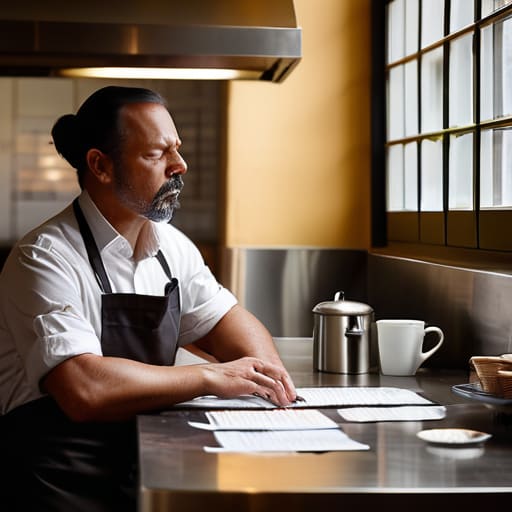
At the end of the day, managing a restaurant while actually working it is a constant, exhausting act of translation. You are translating the numbers on a spreadsheet into the wages for your sous chef, and translating the chaos of a Friday night rush into a sustainable schedule for your front-of-house. You can’t afford to be just a cook, and you can’t afford to be just an accountant; you have to be both, even when your feet ache and the walk-in fridge is acting up again. If you don’t find that balance between protecting your margins and protecting your people, you aren’t running a business—you’re just presiding over a slow-motion collapse.
There will be nights when you sit in the darkened dining room, staring at the empty tables, wondering if the math will ever truly make sense. Some nights, it won’t. But remember that a restaurant isn’t just a collection of line items and food costs; it is a living, breathing thing that you have built from nothing. The goal isn’t to reach a state of perfect, effortless management—that doesn’t exist in this trade. The goal is to build something resilient enough to outlast your own exhaustion, so that one day, you can finally step away and know that the lights will stay on long after you’ve turned them off.
Frequently Asked Questions
How do I stop myself from jumping onto the line every time a server looks overwhelmed, without making my team feel like I don't trust them?
You have to learn the difference between a crisis and a moment of friction. If you dive in every time a server looks frazzled, you aren’t helping; you’re teaching them that they don’t need to find their own rhythm because Rosalind will swoop in. Instead, stand in the pass, keep your hands behind your back, and ask, “What do you need from me?” Give them the tool—a fresh carafe, a clean side plate—not the solution.
At what point do I actually hire a manager, and how do I know if I'm hiring a professional or just paying someone to watch me work?
You hire a manager when your presence has become a bottleneck rather than a backbone. If you can’t step away for a Tuesday lunch without the service collapsing, you don’t own a business; you own a very demanding job. You’ll know they’re a professional when they start spotting the gaps you’re too close to see—like a dwindling stock of decent linens or a server who’s been flagging for three shifts straight. If they’re just mirroring your movements, you aren’t hiring help; you’re just paying for a shadow.
How much of my own salary should I be taking to keep the business healthy versus what I actually need to pay my mortgage?
The short answer is: whatever the business can afford without starving your staff or your suppliers. I know the mortgage pressure is real—I’ve sat in that same chair, staring at a bank balance and wondering if I could skip my own draw to cover a broken walk-in. But if you treat your salary as a fixed cost rather than a variable one, you’ll bleed the business dry. Pay yourself a modest, sustainable wage, and take the rest as a dividend only when the numbers actually allow it.
